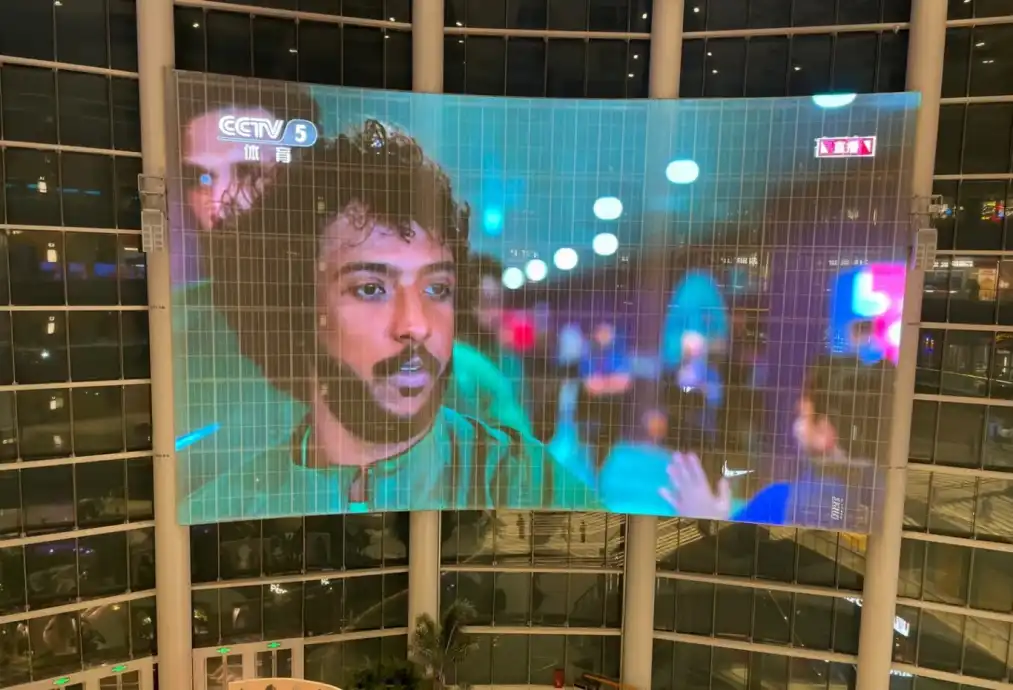
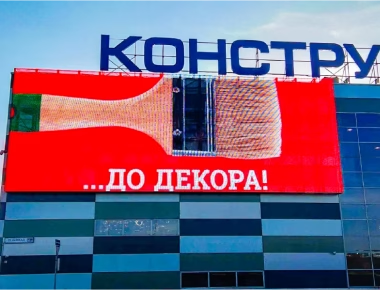
An outdoor LED display must remain readable, serviceable, and safe while exposed to sunlight, rain, dust, heat, cold, and continuous operating demands. Selecting one by price per square meter or maximum brightness alone can leave a buyer with the wrong resolution, an unsuitable enclosure, excessive power consumption, or difficult maintenance access.
This guide is for DOOH media owners, advertisers, contractors, stadium operators, and commercial-property buyers comparing an outdoor LED display screen for a permanent installation. It explains how pixel pitch, brightness, IP rating, cabinet design, control, and structural planning work together in a successful project.
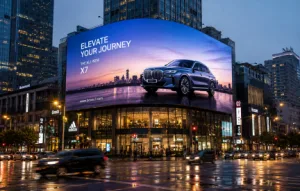
An outdoor screen should be specified from the viewing conditions and installation environment, not from one headline parameter.
Define the Project Before Comparing Products
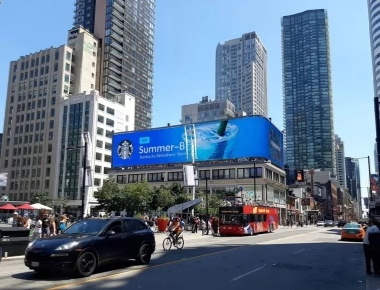
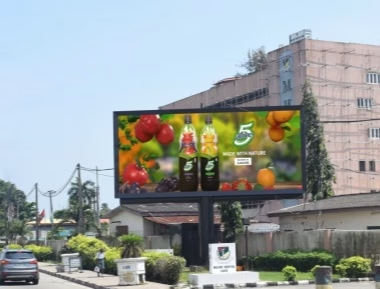
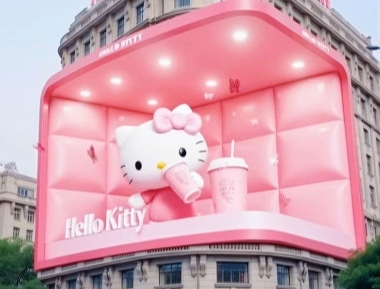
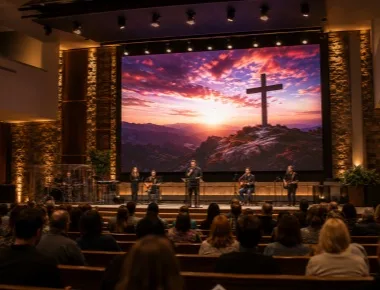
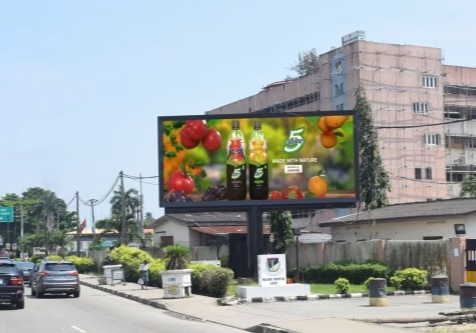
The same LED outdoor display cannot be assumed to suit a roadside billboard, shopping-mall facade, stadium perimeter, drive-through menu board, and pedestrian retail screen. Each application creates different priorities for resolution, brightness, viewing angle, service access, structural loading, and content.
Prepare the following information before requesting a quotation:
- Country, city, and exact installation location.
- Screen width, height, aspect ratio, and preferred orientation.
- Minimum and typical viewing distances.
- Viewing speed: stationary pedestrians, slow traffic, or highway traffic.
- Screen direction and expected direct-sun exposure.
- Ambient temperature, humidity, rainfall, dust, salt air, and altitude.
- Wall-mounted, pole-mounted, rooftop, freestanding, or stadium installation.
- Front or rear maintenance access.
- Operating hours, content type, and remote-control requirements.
- Available electrical supply and local permitting requirements.
Use these inputs to compare the appropriate outdoor LED display configurations rather than asking suppliers for a generic “best outdoor screen.”
How to Choose Pixel Pitch
Pixel pitch is the distance between adjacent pixel centers, stated in millimeters. A smaller pitch places more pixels in the same screen area and can produce finer detail at close range. A larger pitch uses fewer pixels and is often commercially sensible when viewers are farther away.
Pitch selection should start with three connected questions:
- How close will the most important viewer be?
- What native pixel resolution will the proposed screen dimensions create?
- What content must remain legible at that distance and speed?
A close-view retail facade may need detailed product imagery and smaller text. A large roadside billboard is usually viewed from farther away and for only a few seconds, so physical size, contrast, and message simplicity may matter more than very high pixel density. Stadium screens must be evaluated from multiple seating zones and camera positions.
Do not select pitch from a universal distance formula alone. Ask each supplier for the proposed screen resolution and a scaled content simulation. If possible, inspect a working module or comparable installation from the project’s real viewing distance.
| Application |
Pitch Decision Priority |
Content Check |
| Pedestrian retail and drive-through |
Close viewing and detailed content |
Prices, menus, product images, small brand elements |
| Shopping-mall or commercial facade |
Mixed viewing distances and architectural fit |
Campaign creative, video, logos, public information |
| Roadside DOOH billboard |
Distance, traffic speed, and screen area |
Large text, short messages, bold imagery |
| Stadium display |
Seat coverage, camera use, and installation geometry |
Scores, replays, sponsors, live feeds |
Brightness: Specify the Usable Range
Outdoor brightness is measured in nits, but the highest number is not automatically the best choice. Required output depends on screen direction, direct sunlight, surrounding shade, time of operation, local light-control rules, and the display surface.
A south- or west-facing screen exposed to strong afternoon sun may need more output than a shaded facade. The same screen should also dim smoothly at night. Excessive nighttime brightness wastes energy, can reduce viewing comfort, may violate local regulations, and can damage the relationship with nearby residents or road users.
Ask suppliers to distinguish typical operating brightness from maximum brightness and confirm:
- The measured brightness of the proposed configuration.
- Manual and automatic brightness-control options.
- Low-brightness grayscale and color performance.
- Expected brightness uniformity across the full screen.
- How output changes with temperature, power mode, and product age.
For advertising projects, review the intended environment and operating model alongside the available outdoor advertising LED display options. The commercial goal is legible content at the required time of day, not operating continuously at maximum output.
What IP Rating Means for an Outdoor LED Screen
An IP rating describes an enclosure’s resistance to solid-particle and water ingress under defined test conditions. In a two-digit rating, the first digit relates to protection against solids such as dust, and the second relates to water. IP65 is commonly requested for outdoor LED screens: the “6” indicates dust-tight protection, while the “5” relates to protection from water jets.
IP65 does not mean that every part of an installed screen can be submerged, left with open connectors, or operated without drainage. It also does not describe wind resistance, corrosion resistance, UV durability, lightning protection, or performance under long-term condensation.
Clarify the following in the quotation:
- Whether the rating applies to the front, rear, or complete cabinet.
- Whether the tested configuration includes connectors, doors, gaskets, and cable entries.
- The required installation orientation and sealing method.
- Drainage, ventilation, and condensation-control provisions.
- Maintenance steps required to preserve the enclosure performance.
- Whether independent test documentation is available for the offered model.
For coastal, industrial, desert, or high-humidity locations, request additional evidence appropriate to corrosion, salt, dust, and temperature exposure. An IP number should be one part of the environmental specification, not the whole specification.
Cabinet, Structure, and Maintenance Access
The cabinet supports alignment, weather protection, heat management, and component access. The external steel structure or mounting frame carries the complete screen and transfers wind and dead loads to the building, pole, or foundation. These elements must be coordinated by qualified local professionals.
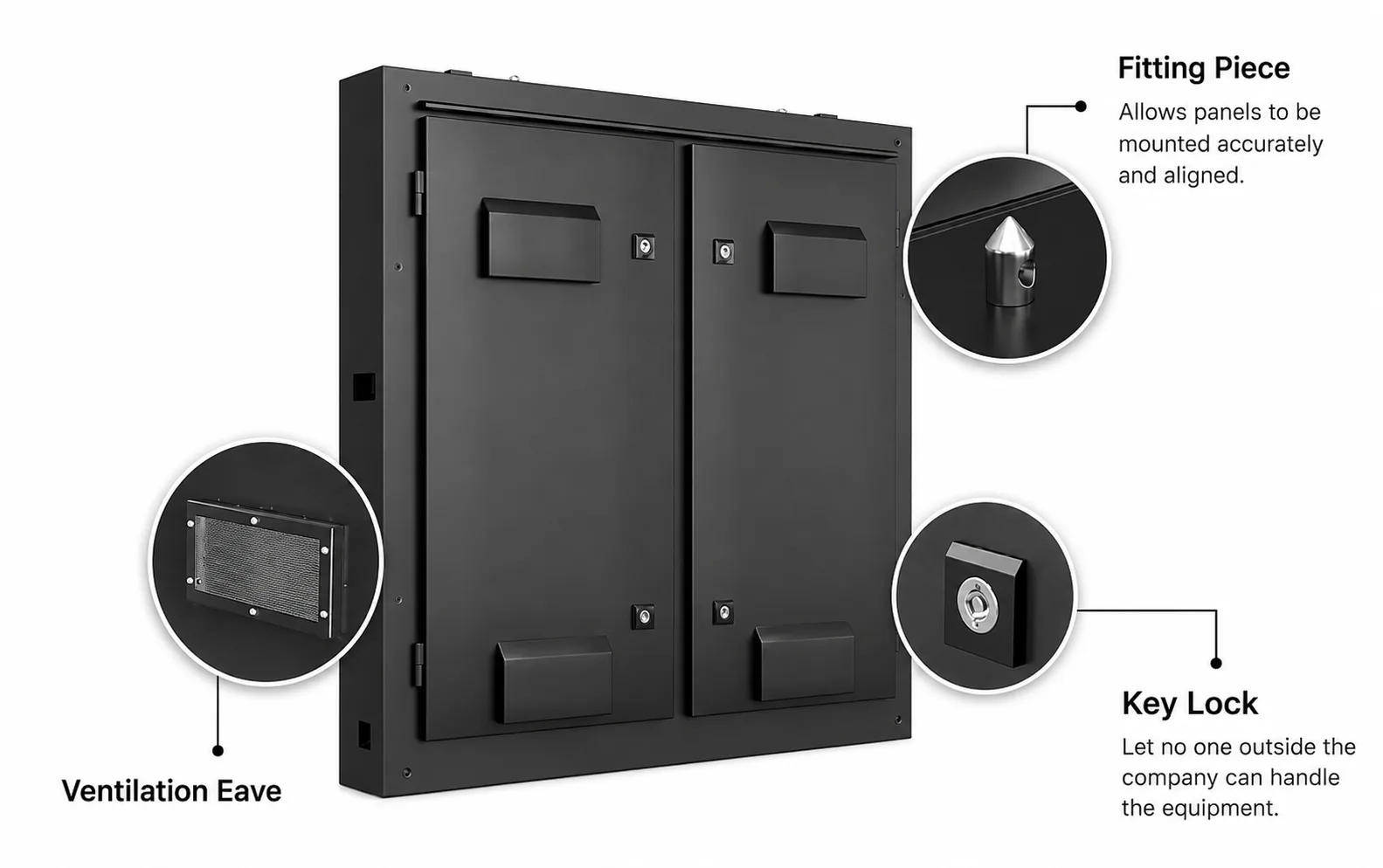
Cabinet sealing, cable routing, drainage, heat dissipation, and service access should be reviewed together.
Front or Rear Service
Rear-service cabinets require safe access behind the display. They can be practical for billboards and structures with a dedicated maintenance walkway. Front-service designs are useful when the screen is mounted close to a wall or where rear space is limited. The correct choice depends on architecture, component-removal method, technician safety, and local service practice.
Wind and Structural Loads
Screen area, elevation, local wind speed, mounting type, cabinet ventilation, and structure geometry all affect the engineering requirement. The LED supplier should provide accurate cabinet drawings, dimensions, weights, and mounting details. A locally licensed structural engineer should determine the supporting structure, fasteners, foundation, and applicable safety factors.
Heat and Drainage
Direct sun, LED output, power supplies, and restricted airflow create heat. Ask how the cabinet removes heat at the project’s expected ambient temperature and whether fans or air-conditioning are required. Water must also be directed away from modules, doors, connectors, and building interfaces rather than trapped behind the screen.
Power Consumption and Operating Cost
Large outdoor screens can operate for long hours, making energy a significant part of lifetime cost. Compare maximum power, typical operating power, brightness schedule, ventilation or cooling load, and standby consumption. Do not calculate the electrical system from an optimistic average figure alone; the distribution system must support the engineered load and local electrical code.
Ask for an annual energy estimate based on the planned operating schedule and brightness profile. A useful comparison should also include maintenance labor, spare parts, access equipment, connectivity, software, insurance, and expected downtime—not only electricity.
Image Quality Beyond Pixel Pitch
Two screens with the same pitch can perform differently. LED package quality, driver configuration, scan method, grayscale processing, refresh rate, mask design, calibration, module consistency, and video processing all affect the result.
For DOOH and commercial-property projects, test:
- Color and brightness uniformity across cabinets.
- Dark scenes and gradients at reduced brightness.
- Fine text and brand colors from realistic viewing positions.
- Camera behavior if the display will appear in broadcasts or social media.
- Content scaling at the screen’s native resolution and aspect ratio.
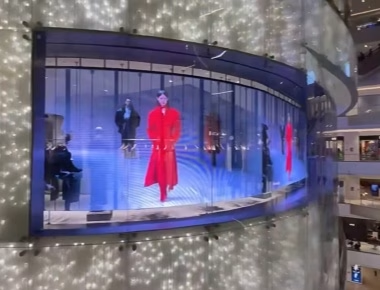
Commercial environments with shorter viewing distances may benefit from a configuration tailored to close-range brand content. Buyers can compare these requirements with the dedicated commercial LED display range.
Control, Connectivity, and Redundancy
A permanent outdoor display needs a dependable content and monitoring workflow. Confirm how media is scheduled, how the player reconnects after a power or network interruption, and who receives fault alerts. If advertising revenue or stadium operations depend on uptime, discuss redundant power, signal paths, controllers, network links, and emergency content procedures.
Remote monitoring may include temperature, cabinet status, power, communication, brightness, and playback information, but available functions depend on the selected hardware and software. Request a live demonstration and define user permissions, data retention, cybersecurity responsibility, and ongoing license costs.
Application-Specific Buying Priorities
| Buyer |
Main Priorities |
Commonly Missed Item |
| DOOH media owner |
Uptime, brightness control, remote monitoring, energy, service response |
Revenue impact and access cost during a failure |
| Advertising buyer |
Audience distance, content legibility, campaign scheduling, image consistency |
Native resolution and creative-production workflow |
| Contractor |
Drawings, weights, interfaces, wiring, drainage, commissioning documents |
Responsibility boundaries between trades |
| Stadium operator |
Viewing coverage, safety, cameras, redundancy, rapid maintenance |
Access during events and spare-parts strategy |
| Commercial-property owner |
Architectural fit, daytime visibility, nighttime control, operating cost |
Planning approval and neighborhood light impact |
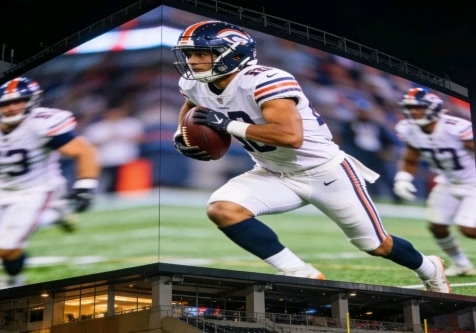
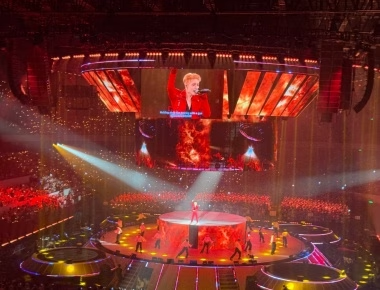
Stadium projects require the screen, structure, content, cameras, control, and maintenance plan to work as one system.
How to Compare Supplier Quotations
Send every supplier the same project brief and request a line-by-line scope. A complete quotation should identify the proposed module and cabinet, screen resolution, control system, power estimate, maintenance method, spare package, mounting interfaces, documentation, testing, packing, shipping terms, lead time, warranty, and support process.
Ask what is excluded. Steelwork, foundations, lifting equipment, electrical distribution, permits, data service, installation labor, and local certification may be supplied by different parties. Unclear scope is a common source of budget overruns and schedule delays.
For billboard projects, use an application-level reference such as the outdoor LED billboard solution to identify the display, structure, control, maintenance, and environmental questions that belong in the RFQ.
Pre-Shipment and Site Acceptance
Agree on measurable acceptance criteria before production. Factory testing should use the final cabinet configuration, control files, and representative content. Inspect brightness and color uniformity, dead or abnormal pixels, cabinet alignment, low-brightness gradients, remote-control functions, protection details, spare parts, labeling, and packing.
Site acceptance should also confirm the supporting structure, grounding, power distribution, drainage, ventilation, network connection, brightness schedule, emergency shutdown, and maintenance access. Keep final configuration files, wiring drawings, calibration data, passwords, manuals, and spare-parts records under controlled ownership.
Frequently Asked Questions
What pixel pitch is best for an outdoor LED display?
The best pitch depends on screen size, closest important viewing distance, audience speed, content detail, and budget. Compare the resulting native resolution and test representative content instead of choosing from a pitch number alone.
How bright should an outdoor LED screen be?
Required brightness depends on screen direction, direct sunlight, shade, operating hours, surface design, and local light restrictions. Specify a usable daytime-to-nighttime range with automatic or scheduled dimming where appropriate.
Is IP65 enough for every outdoor installation?
No. IP65 addresses dust and water-jet ingress under defined conditions, but it does not cover every environmental or structural risk. Confirm which cabinet surfaces are rated and separately evaluate drainage, condensation, corrosion, heat, wind, UV exposure, and connectors.
Should an outdoor LED display use front or rear maintenance?
Choose according to the building interface and safe technician access. Front service is useful when rear space is restricted; rear service can work well where a protected maintenance walkway is available. Component replacement should be demonstrated before approval.
What information is needed for an accurate quotation?
Provide the installation location, screen dimensions, viewing distance, orientation, environment, mounting method, brightness and resolution expectations, operating hours, quantity, timeline, and budget range. Include drawings, site photos, power information, and permit requirements when available.
Final Buying Advice
An outdoor LED screen display is a long-term operating asset, not just a collection of modules. Pixel pitch controls how resolution relates to viewing distance; brightness must work across daylight and nighttime conditions; and IP rating must be supported by correct cabinet sealing, drainage, installation, and maintenance. Structure, power, heat, content control, service access, and supplier support are equally important.
For a project-specific recommendation, provide the location, dimensions, viewing distance, expected pixel pitch or brightness requirement, quantity, installation method, operating schedule, delivery timeline, and budget range. These details make it possible to prepare a technically comparable quotation instead of a generic price.